
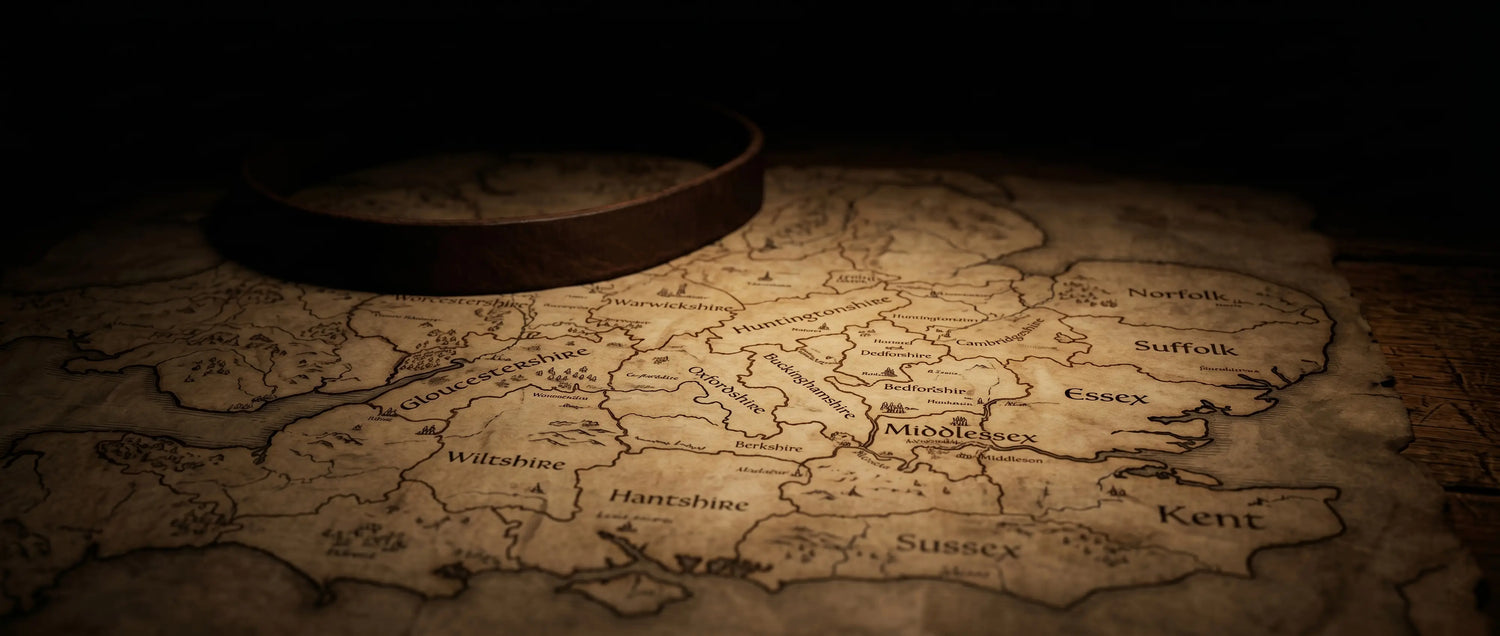
VOLUME III: THE GEOGRAPHY OF HERITAGE
The mapping of the soul and the definitive atlas of our collections.
The Prologue: The Island of Kings and Ghosts
Before the map of England was drawn in ink, it was carved in iron, oak, and stone. To understand the architecture of a Caracoda Equestrian piece, you must first understand the landscape that demanded it. We do not look to the polished modern era for our inspiration; we look to the turbulent, magnificent dawn of ancient Britain—a time when survival required uncompromising strength and a deep, sovereign dignity.
THE DEPARTURE OF THE EAGLES
Our timeline begins in the 5th century, in the damp chill of a profound silence. After four hundred years of rule, the Roman legions withdrew from Britain, marching away to defend a crumbling empire and leaving the island to fend for itself. They left behind a landscape of monumental ghosts: towering stone walls, paved roads stretching straight into the wild, and massive coastal fortresses slowly being swallowed by the sea. The native Britons were left holding the keys to cities they could no longer defend.
THE BIRTH OF THE SEVEN KINGDOMS
From across the grey, churning waters of the North Sea came the longships. The Angles, the Saxons, and the Jutes arrived not just to raid, but to settle. They did not build in stone; they built in heavy timber and iron. They pushed through the deep, ancient forests and established their own realms, carving the island into the Heptarchy—the Seven Sovereign Kingdoms.
This was the age of the warrior-king and the great mead halls. Kingdoms like Northumbria, Mercia, and Wessex rose to power, possessing their own laws, their own saints, and their own fierce identities. It was a brutal, beautiful era where wealth was measured in gold hoards buried in the earth and loyalty was sworn on the hilt of a sword.
THE VIKING STORM AND THE BURH DEFENSE
In the 9th century, the horizon darkened again. The Great Heathen Army of the Vikings descended upon the island, sweeping away kingdoms that had stood for three hundred years. Only Wessex, under the rule of King Alfred the Great, held the line in the marshlands.
To save his people, Alfred reimagined the landscape. He ordered the creation of the Burhs—a vast, interconnected network of fortified market towns. He decreed that no man, horse, or harness should be more than a day's ride from safety. These Burhs transformed the wild countryside into a grid of urban resilience, merging the daily business of trade with the absolute necessity of defense.
THE EDGES OF THE WORLD
Beyond the safety of the heartland lay the wild frontiers. To the south and east, the desolate marshes and chalk cliffs of the Sussex and Saxon Shores stood battered by the salt wind, guarded by solitary sentries watching for the next wave of invaders. To the far north and west, the mists of Dalriada concealed a rugged, maritime Gaelic world where massive stone monoliths and deep lochs defied the reach of any king.
THE CRAFT OF THE ANCIENT WORLD
Throughout this millennium of upheaval, one thing remained constant: the reliance on leather. Before plastics and synthetics, the skin of the beast was the primary armor of the working world. It was used to hinge great oak doors, to rig the sails of the longships, and to saddle the warhorses that shaped the borders of the realm. It had to be thick, it had to be fed with fats and tallows, and it had to endure.
This is the world Caracoda Equestrian resurrects. When we reclaim a vintage saddle and cut it into a new silhouette, we are not just making a bag. We are binding the spirit of the Heptarchy, the urban defense of the Burhs, and the wild maritime edge of Dalriada into a vessel you can carry today.
To carry a piece of Caracoda Equestrian is to carry a fragment of the old English landscape. Our workbench does not operate on modern fashion seasons; it operates on history. We have organized our entire workshop into a geographical timeline—a comprehensive architectural registry that traces the defense, the trade, and the sovereign power of the ancient world.
This is the map of our heritage. From the grand houses of the first kings to the salt-battered walls of the coastal sentries, these are the five foundational lineages of our craft.
Welcome to the Geography of Heritage. Choose your realm.
I. The Heptarchy: The Sovereign Kingship
Before England was one, it was seven sovereign kingdoms. These models are our "Great Houses". Named after the ancient realms—such as Wessex, Mercia, and Northumbria—these pieces are grand, imposing, and carry the structural dominance and status of an Earldom. They are the sovereigns of our workshop, possessing an architectural weight that demands you stand a little straighter when you carry them. Every piece carries the DNA of the landscape that inspired it.
II. The Burh System: Trade & Defense
In the face of ancient invasions, King Alfred the Great mapped out a network of fortified market towns—the Burhs. Inspired by these 9th-century strongholds, the Burh collection moves away from organic curves and embraces a "Walled Logic". These bags are built for the "marketplaces" of modern life. They are structured, urban, and designed precisely for the intersection of daily trade and unyielding defense.
III. The Sussex Shore: Coastal Resilience
Where the heavy clay of the English timberlands meets the relentless assault of the sea, the Saxon Shore forts stood watch. Named for the coastal fortresses that stood against the grey North Sea, these are our most rugged pieces. The Sussex Shore collection is resilience personified—weather-beaten, steadfast, and ready for the salt and the wind. Every piece is anchored to the very soil of the coast through the engraving of its precise geographic coordinates.
IV. The Dalriada: The Western Seaways
Sailing past the western edge of the text, the horizon shifts to the mist-shrouded sea-kingdom of the north. The Dalriada collection is a nod to the maritime strength and the ancient Gaelic overlap of the Highlands and Islands. These are the Gaelic Monoliths: hardware-free vessels utilizing the natural tension and friction of heavy saddle leather. These pieces are for the adventurers—those whose hearts pull them toward the northern mists and the rugged coastlines.
V. The Keep Essentials: The Inner Sanctuary
Every fortress requires a core defense. The "Keep" is the strongest, inner-most sanctum of a castle. This collection serves as the unyielding anchor of the Caracoda Equestrian workshop. It holds our indispensable daily tools—the pieces you never leave behind, even when the rest of the world is at the gates.