
VOLUME IV: THE STEWARDSHIP
The Apothecary Rites and the timeline of patina.
The Custodian's Covenant THE PROLOGUE: THE HANDOVER OF HISTORY
When a piece of Caracoda Equestrian leaves our workbench, it does not leave its history behind; it simply changes hands. You are now the guardian of a material that has spent half a century or more in the company of horses and the rhythm of the English seasons. The scent of the workshop-the woodsmoke, the amber beeswax, and the heavy, honest musk of ancient harness leather is now the scent of your own journey. We do not view our customers as mere owners, but as Sentries. To carry a Tamworth, a Winchester, or a Glencoe is to accept a seat at a table that spans centuries. The leather in your hands is a survivor. It has been resurrected through fire, oil, and the patient labor of the hand-stitch. But for this resurrection to be permanent, the dialogue between the hide and the navigator must continue. This Volume is not a set of instructions; it is a philosophy of care a guide to ensuring that your artifact grows stronger, deeper, and more beautiful with every mile you cover.
I. THE PHILOSOPHY OF FEEDING: WHY WE RE-BALM
In the modern world, we are taught to "clean" things to strip away the evidence of life until a surface is sterile and characterless. At Caracoda Equestrian, we reject this. We do not "clean" our bags; we feed them. Vintage saddle leather is a biological material. Even after its first life on the horse is over, the fibers remain a complex network that requires nourishment to stay supple. Over time, the sun, the wind, and the dry air of modern homes can "starve" these fibers, causing them to become brittle. Re-balming is the act of returning the life-force to the skin.
The Result of the Ritual
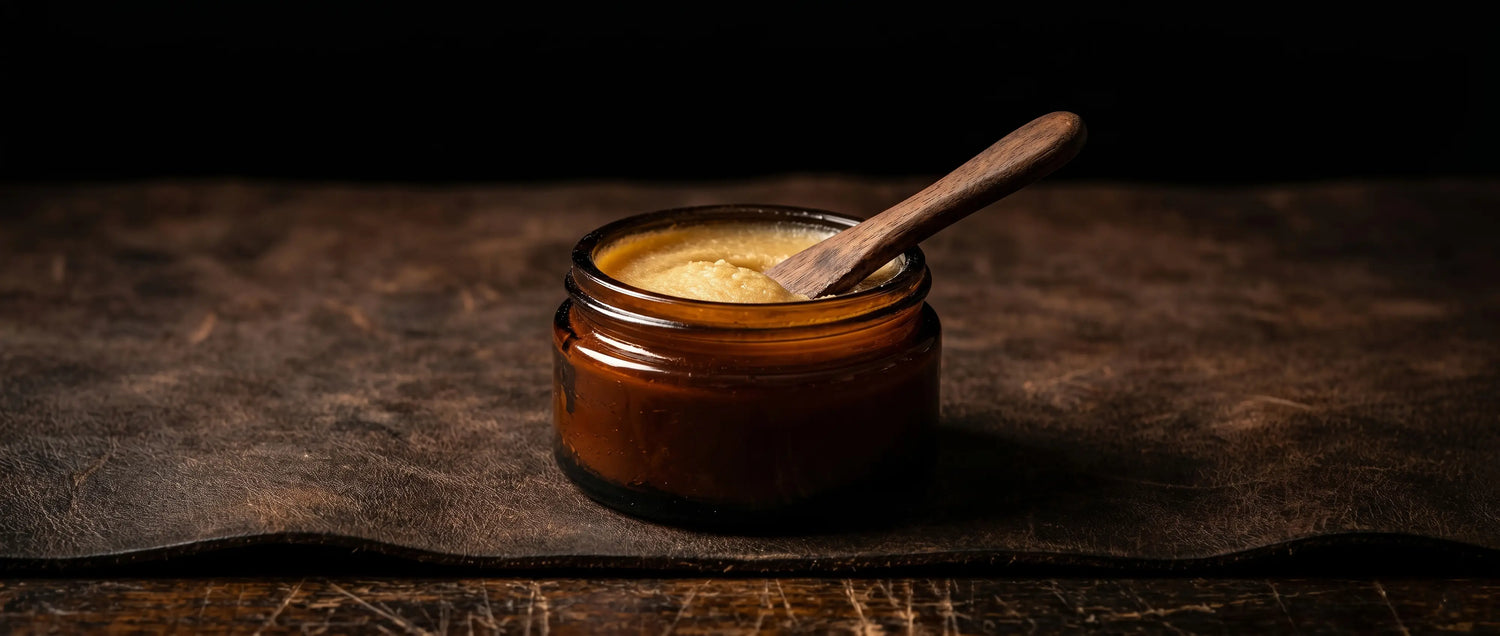
When you apply the Caracoda Hebridean Balm, you are performing three vital functions:
- Deep Hydration: The Pure Neatsfoot Oil travels deep into the core of the 5 mm hide, lubricating the individual fibers so they can slide against one another without snapping. This is what gives your bag that distinctive, heavy- drape "leather-clank" rather than a stiff, plasticky crackle.
- Structural Softening: The Unrefined Shea Butter works on the surface grain, keeping it resilient and "plump." This prevents the fine spider-webbing of cracks that usually destroys old leather, ensuring the "Seat" of your bag remains as smooth as the day it was salvaged.
- The Atmospheric Shield: The Natural Beeswax creates a breathable, waterproof barrier. It sits on the surface, sealing the history within and locking the moisture out. It provides that soft, matte luster known as the "Caracoda Glow"-a sign that the bag is healthy and defiant against the elements.
II. THE TIMELINE OF PATINA: THE RECORDING OF A LIFE
A new bag is a blank page; a Caracoda Equestrian bag is a manuscript with the first few chapters already written. The beauty of reclaimed harness leather is that it is a "recording device." It does not wear out; it evolves.
- The Settling (Year 1): During your first four seasons together, the bag is learning your anatomy. The Gaelic Monoliths, with their hardware-free tension, will begin to soften and "remember" the specific way you move. The "Natural Hay" thread will begin to age, absorbing the oils from the balm and the dust of the road, shifting from a bright grain-color to a deep, golden tobacco.
- The Bronzing (Year 5): This is the era of the "High Luster." By now, the repeated ritual of feeding and the friction of your clothing will have polished the leather into a translucent bronze. The chocolate tones of the Mercian collection or the deep russets of the Dalriada will gain a "three-dimensional" depth. You will see the original "Ghost Stitches" from the 1950s saddle interacting with the new marks of your own decade.
- The Artifact Phase (Year 10 and Beyond): At this stage, the bag has become an heirloom. It no longer looks like a restored item; it looks like an ancient artifact that has somehow remained perfectly functional. The leather will feel like a second skin-dense, heavy, but incredibly soft to the touch. It has become a piece of Living History.
III. THE ART OF THE NEW NARRATIVE: EMBRACING THE MARK
We often receive inquiries asking how to remove a scratch or hide a stain. Our answer is always the same: Do not. The marks on your bag are the footnotes of your navigation. A scratch from a briar in the Highlands is not a blemish; it is a memory of a wild path taken. A spill of ink in a Winchester café is not a defect; it is a recording of a moment of inspiration. These are the "New Scars" that join the old ones. At Caracoda Equestrian, we encourage our custodians to never hide the evidence of their journey. To "fix" a mark is to erase a chapter of your own story. Each time you re-balm your bag, you aren't wiping these marks away; you are "varnishing" them into the history of the piece. You are making them permanent. A well-traveled bag should look like it has seen the world. It should look like it has been part of a life well-lived.
FINAL INTERNAL RECORD: THE SENTRY'S WARNING
While we celebrate the marks of life, we must guard against the "True Enemies" of the hide: Salt and Direct Heat.
- The Salt-Wind Protocol: If your watch takes you to the Sussex Shore, the salt-spray can crystallize within the leather fibers, acting like tiny shards of glass that cut the hide from the inside out. If your bag is soaked in seawater, do not panic. Wipe it down gently with a cloth dampened in fresh water to draw out the salt, allow it to air-dry naturally, and then perform a "Deep Feed" with the balm to restore the protective beeswax shield.
- The Fire Warning: Never, under any circumstances, place your bag near a radiator, a hair-dryer, or an open hearth to dry it. Direct heat "shocks" the moisture out of the leather, causing the fibers to shrink and the historic grain to crack. Patience is the craftsman's primary tool; let the air do the work.
Between Us: The Custodian's Legacy
When you eventually pass this bag to the next generation, you aren't just giving them a piece of luggage. You are giving them the saddle of an unknown rider from 1940, the craftsmanship of a 21st-century workshop, and the recorded biography of your own life. You are handing over a century of endurance. Carry it with the gravity it deserves.