
VOLUME I: THE PHILOSOPHY OF THE HIDE
The 'Zero-New-Leather' Creed and the reclamation of English heritage.
THE 'ZERO-NEW-LEATHER' CREED
We are often asked why we make life so hard for ourselves. It would be a simple thing to pick up a telephone, call a tannery, and order a pristine, uniform roll of Grade-A vegetable-tanned leather. It would be clean, predictable, and easy to cut. But Caracoda Equestrian was not built on the easy path. Our Creed is a refusal. We refuse to participate in the cycle of modern extraction. We believe that every square inch of leather needed to create a masterpiece already exists, tucked away in the rafters of old stables or forgotten in the corners of tack rooms. This philosophy creates a different kind of luxury—one built on Restoration over Extraction.
THE UNSEEN LABOUR
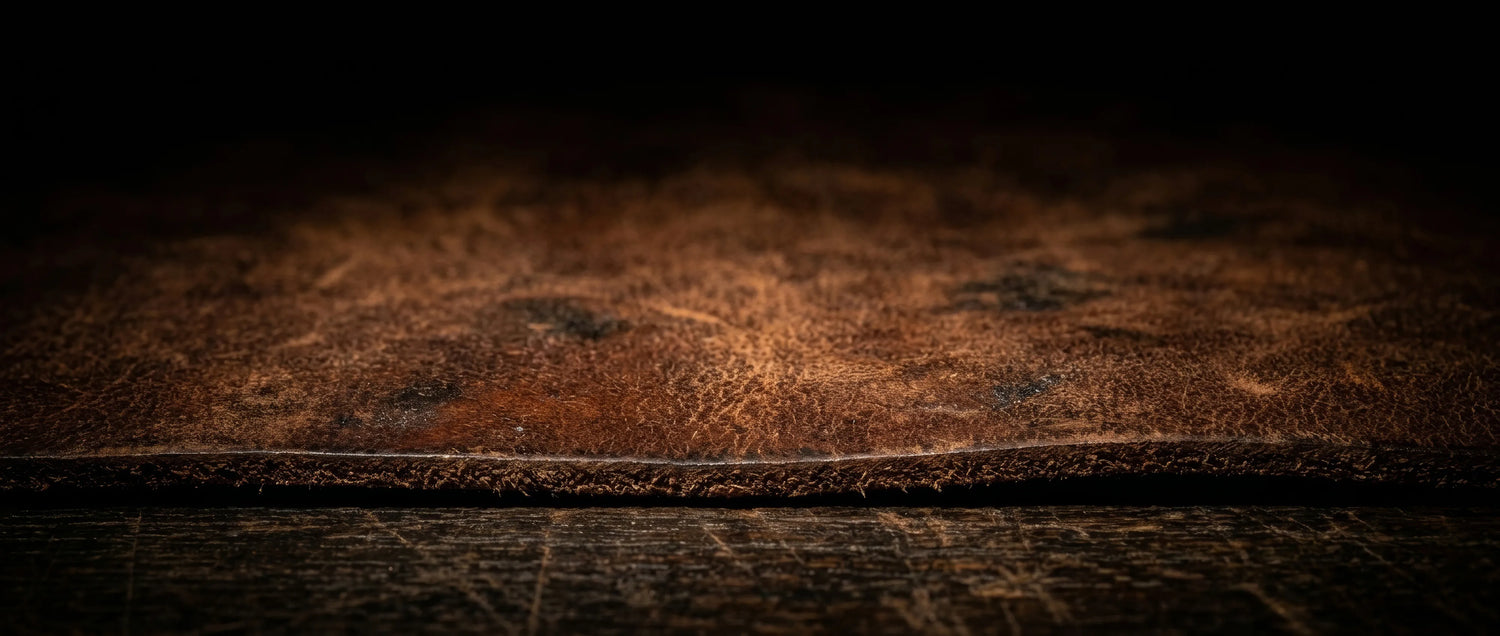
To the untrained eye, a vintage saddle—cracked, grey with dust, and stiff with age—is a relic destined for the scrapheap. To us, it is a treasure waiting to be unburdened. The process of adhering to a "Zero-New-Leather" mandate is a gruelling, physical journey that begins long before a needle ever touches a hide.
Our time and petrol are spent scouring the English countryside, hunting for saddles that possess the right weight, the right history, and a soul worth saving. When we bring a saddle onto the workbench—often acquired for a few pounds because the world saw it as "past its prime"—we are not just "upcycling" material. We are performing a reclamation of English heritage. We must read the history of the hide in the field: searching for the faint stamp of a master saddler, feeling the skirts for the fatal, powdery decay known to archivists as "red rot," and assessing whether the core fibres can survive the crucible of our workshop.
We spend hours in the heavy work of disassembly. We must carefully remove rusted steel nails, unpick decades-old linen thread, and strip away the internal structures of iron, wood, and wool. It is a process that is physically demanding and technically delicate; one wrong move can destroy a fragment of history that cannot be replaced.
Because each saddle is a unique "diamond in the rough," there is no template. We must "listen" to the leather, working around ancient marks, honoring the scars of past rides, and using our alchemical conditioners to stabilize fibers that have reached the limit of their endurance.
THE TRINITY: THE SACRED BALM
In the workshop of Caracoda Equestrian, we do not trust chemicals born in a laboratory to save a hide that was born in a pasture. To restore the ancient fibers of a saddle that has sat silent for half a century, we must return to the elements. We call our restoration formula "The Trinity." It is a precise, carefully balanced union of liquid oils, hard botanical butters, and natural waxes. We don't measure it by modern industrial standards, but by the needs of the leather itself; each saddle, depending on its age and state of neglect, requires its own unique recipe and ratio of ingredients. This is the first act of alchemy: the moment the dry, brittle ghost of a saddle begins to breathe again.
Vintage leather is often "dead" to the touch because its internal lubrication has evaporated, leaving the microscopic fibers to grind against one another until they snap. Our liquid oils—pure, high-grade extracts like Neatsfoot or Sweet Almond—act as the seekers. Because they remain fluid, they are able to dive deep, traveling through the pores to reach the very core of the hide. They don't just sit on the surface; they find the "soul" of the leather and restore its internal movement.
Where the oil provides movement, the hard butters—unrefined Shea or rich Cocoa—provide the body. These fats are solid at room temperature but melt at the touch of a human hand. For a reclaimed saddle, these butters act as a restorative meal. They fill the microscopic voids left by decades of neglect, giving the leather that heavy, supple "hand" that distinguishes a Caracoda Equestrian piece. It is this element that transforms a stiff, board-like fragment into something that feels alive.
The final element of the Trinity is the seal. Natural beeswax is the guardian of the process. It doesn't just provide a beautiful, low-lustre finish; it bonds with the oils and butters under the heat of the artisan's friction to create a breathable, water-resistant barrier. It locks the nourishment in and keeps the British weather out. It is the final promise that this restored history will survive the next century of use.
The true secret of the Trinity isn't just the ingredients—it is the application and the patience that follows. It requires the heat of a palm and the discipline of a scholar to work the balm into the grain until the leather "sighs" and softens. Once nourished, the hide is placed into a temperature-controlled dark space to cure. It must rest, sometimes for days, allowing the heavy balms to fully integrate with the cellular structure before a single blade or awl can safely pierce it. When you hold a finished bag, you are feeling the results of this quiet, rhythmic resurrection. Yet, it must be noted that while the Trinity is the pillar of our work, it is only the beginning. Apart from these three, we employ many other bespoke formulations and secret recipes—each developed for a specific purpose—to navigate the unique complexities of every hide that crosses the workbench.
THE STEWARDSHIP OF SAFETY
There are rare instances where the path of restoration meets the requirement of modern safety. Specifically for load-bearing shoulder or crossbody straps, a customer may request the use of new leather. In cases where the original reins or stirrup leathers are missing, or where decades of hard riding have compromised the fiber beyond the point of safe utility, we honor the necessity of strength. This is not a compromise of our values, but a commitment to the owner's peace of mind—ensuring that while the body of the bag carries the past, the strap that secures it to your person is unyielding and safe for the journey ahead.
THE MIRACLE OF THE SECOND LIFE
This is the core of our pricing logic and our commitment to the craft. People often ask if providing their own heirloom saddle will lower the price of a bag. The answer, rooted in the honesty of the workbench, is no. You are not paying for the raw material; you are paying for the resurrection. The cost of a Caracoda Equestrian piece reflects the immense energy, the petrol for the search, the specialized chemistry, and the hard-won expertise required to make "dead" leather safe, supple, and beautiful again. The preparation of a single vintage saddle is a high-cost investment in time and skill that far exceeds the price of buying new. We do not charge for the leather—we charge for the miracle of its second life.